The comfort of a SPA requires hydraulic components capable of making the difference.
Heated pools, emotional showers, whirlpools… this is what most people think of when they think of a Spa and the use of water for wellness.
But behind all this there is a hydraulic system that must take into account high flow rates, variable temperatures, continuous use, hygiene requirements and high comfort. The goal is to ensure the best possible user experience and complete system safety. Consequently, not only must the design be particularly accurate, but the choice of hydraulic components is also very important and can make the difference, immediately and especially in the long term.Pressure boosting systems for optimal water management.
In a context where water uses are multiple and simultaneous, it is essential to ensure constant pressure.
In modern spa hydraulic systems, pressure boosting units with integrated inverter represent the ideal solution, as they guarantee constant comfort and energy savings. Thanks to variable speed technology, these systems modulate the performance of electric pumps in real time based on actual water demand, maintaining stable pressure even when flow rates vary.

Electronic control reduces consumption, limits inrush currents and component wear, while improving system quietness and reliability: a fundamental advantage in wellness environments, where acoustic comfort and operational efficiency are priorities.
Expansion vessels are also often used for system stability, thanks to their ability to compensate for flow variations and prevent continuous pump restarting.
Valves, manifolds and fittings: the smart choice of stainless steel.
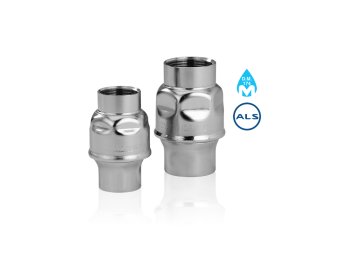
Valves are hydraulic components installed at various points in a spa’s hydraulic system and play an essential role in system control. Think of shut-off valves, necessary for line isolation, safety and maintenance without system downtime. Or check valves, installed to protect electric pumps or to prevent contamination and backflow between circuits.
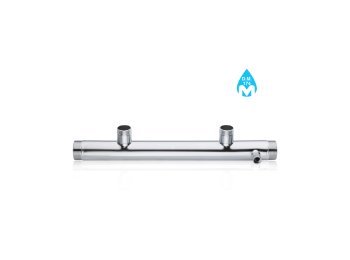
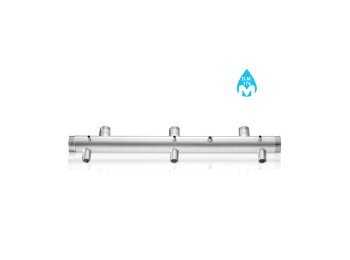
If valves play a crucial role in ensuring comfort and safety by regulating flows, isolating lines during maintenance and protecting the system from overloads or anomalies, manifolds are no less essential. These hydraulic components are responsible for organizing system complexity. A spa is a complex system, with many users operating simultaneously. Manifolds distribute water efficiently, maintaining balance between flow rates and pressures. Well-designed distribution and the possibility of creating modular configurations are the basis of a reliable and orderly system.
There are also fittings in various types, used to create connections, connect branches, close manifolds or create access points to the system.
For all these hydraulic components — valves, manifolds and fittings — choosing stainless steel offers significant advantages.
Choosing components made of Aisi 304 and Aisi 316 stainless steel, with their very high corrosion resistance, means investing in:
- long-term reliability
- safety and hygiene
- reduced maintenance costs
In addition, stainless steel is a sustainable material, 100% recyclable and aligned with the constant pursuit of energy savings thanks to the reduced pressure losses ensured by the smooth surface of these components.
Water treatment and quality.
The pool is a central element of the wellness experience. Whether it is heated pools, whirlpools, sensory paths or infinity pools, every detail of the system is designed to ensure safety, quiet operation and impeccable hygiene, creating a welcoming environment in which water becomes the protagonist of the wellness journey. To ensure water that is always clear, safe and perfectly sanitized, efficient circulation and filtration systems are required, correctly sized according to pool volume and type, and naturally combined with proper chemical disinfection. Only the integration of reliable technology, proper system design and constant maintenance makes it possible to maintain the level of water quality that a Spa must offer.
If the Spa enters the home.
The same principles also apply when choosing to build a Spa in a domestic environment. Bringing wellness into the home does not simply mean installing a mini-pool or a whirlpool tub, but designing an adequate, safe and reliable hydraulic system. Even in residential settings, it is essential to pay attention to pressure management, material quality, water treatment and energy efficiency, relying on components designed for continuous and silent operation. A well-designed private Spa is the result of technical knowledge and conscious system choices, enabling high comfort, ease of management and lasting daily wellness.